
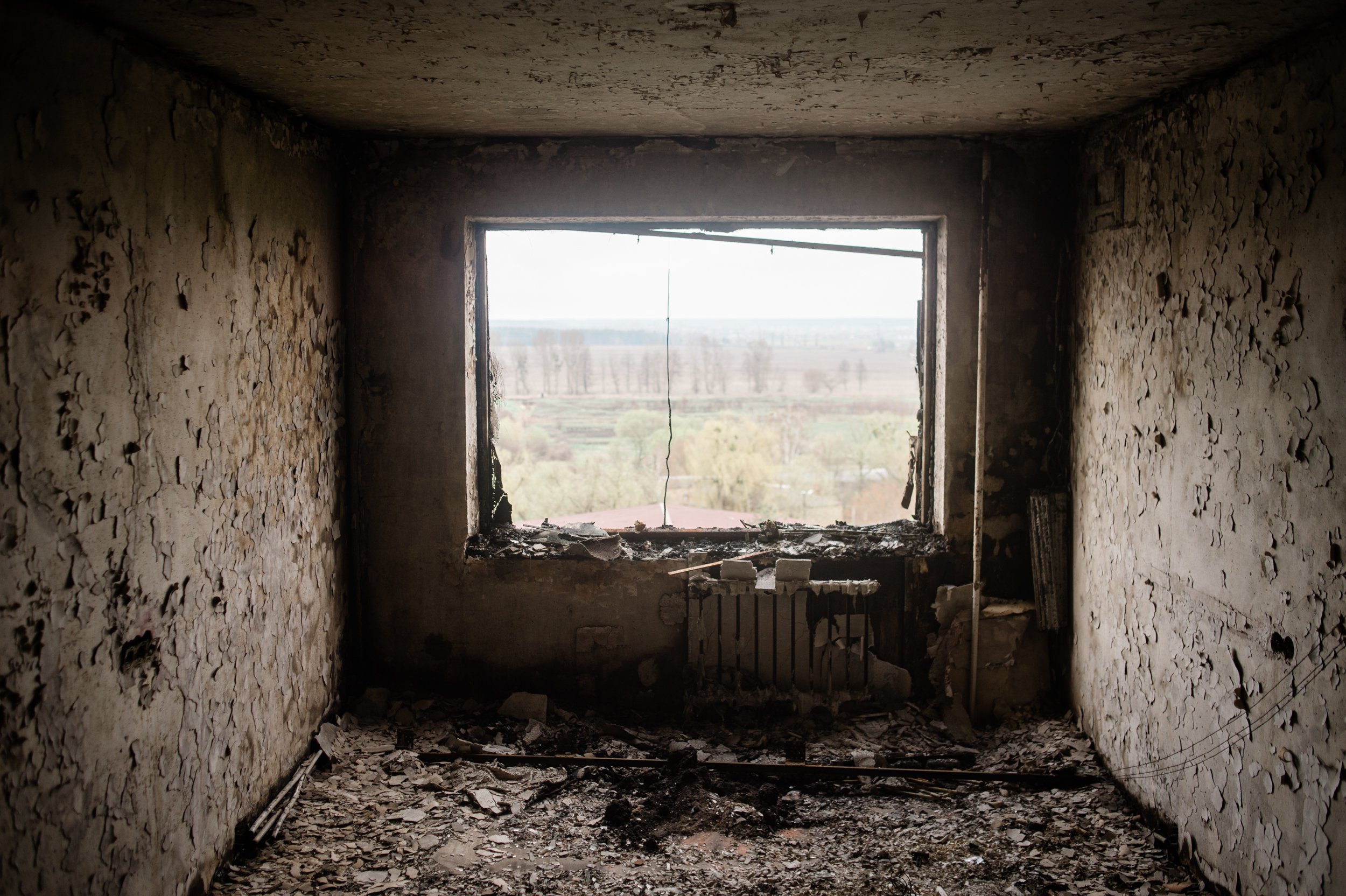
REPORTING ABROAD: UKRAINE
A Wilmington photojournalist’s glimpse of a country’s defiant defense against the Russian invasion.
I couldn’t resist any longer. On April 6, day 42 of Russia’s increasingly barbaric invasion of Ukraine, I set off with a reporter from Atlanta, Patrick Adams, to see it for myself. The Russians were retreating from their feckless yet brutal attempt to capture Ukraine’s capital, Kyiv, and reports were accumulating of executed civilians lining the roads of the rural suburbs north of the city. A World War II-style siege of the industrial port city of Mariupol, nearly 300 miles to the southwest, had already killed an estimated 5,000 civilians, according to the city’s mayor. Less than a week later the estimate had doubled.
"The world has not seen the scale of the tragedy in Mariupol since the existence of the Nazi concentration camps,” Mayor Vadym Boichenko stated on the day of my departure, calling his city “the new Auschwitz and Majdanek.”
In Warsaw, itself blitzkrieged by its neighbor more than eight decades ago, symbols of Poland’s support of Ukraine were numerous: Blue and yellow flags lined New World Street; anti-war messages were written on windows and mirrors in businesses throughout Old Town; yellow posters depicted Russian President Vladimir Putin’s face as part of the old Nazi skull-and-crossbones symbol, between the words, “Achtung (Danger) Russia!”
When we arrived at the Polish border town of Przemysl, hundreds of Ukrainians were boarding a train for a short ride to Lviv, a city known as Ukraine’s “capital of culture” near the Polish border. (According to data gathered by the United Nations Refugee Agency, as of April 24, roughly 5.3 million Ukrainians had fled the country since the start of the war, while nearly $1.2 million had reentered the country.)
Far removed from the fighting in the east, Lviv had become a safe haven for refugees, journalists, aid workers, and diplomats. Foreign embassies, including those of the U.S., Germany and the Netherlands, had in mid-February relocated to temporary embassies in the city as a massive buildup of Russian troops along Ukraine’s eastern border indicated an invasion was inevitable.
Thousands of people crowded the cobblestone streets of Lviv’s Old Town – a UNESCO World Heritage site and capital of the Kingdom of Ruthenia in the 11th century – as old yellow trams and buses ferried people around the bustling city. It was a stark contrast to what I would see later in Kyiv and Kharkiv further east.

On the day of my departure to Warsaw, a statue painted in the colors of the American flag tips his hat to passengers at John F. Kennedy International Airport, April 6, 2022.

A painting of Ukrainian President Volodymyr Zelensky, who has gained worldwide fame for his country’s resistance to the Russian invasion, is displayed by a street merchant in Warsaw, Poland, April 8, 2022.

Passengers at the central train station in Lviv, western Ukraine, disembark from a train arriving from the Polish border town of Przemyśl just before midnight on April 14, 2022. As of April 23, data gathered by the United Nations showed nearly 5.3 million Ukrainians have left Ukraine since the start of the war on Feb. 24, while more than a million have re-entered. It is unclear how many of these returns are permanent.
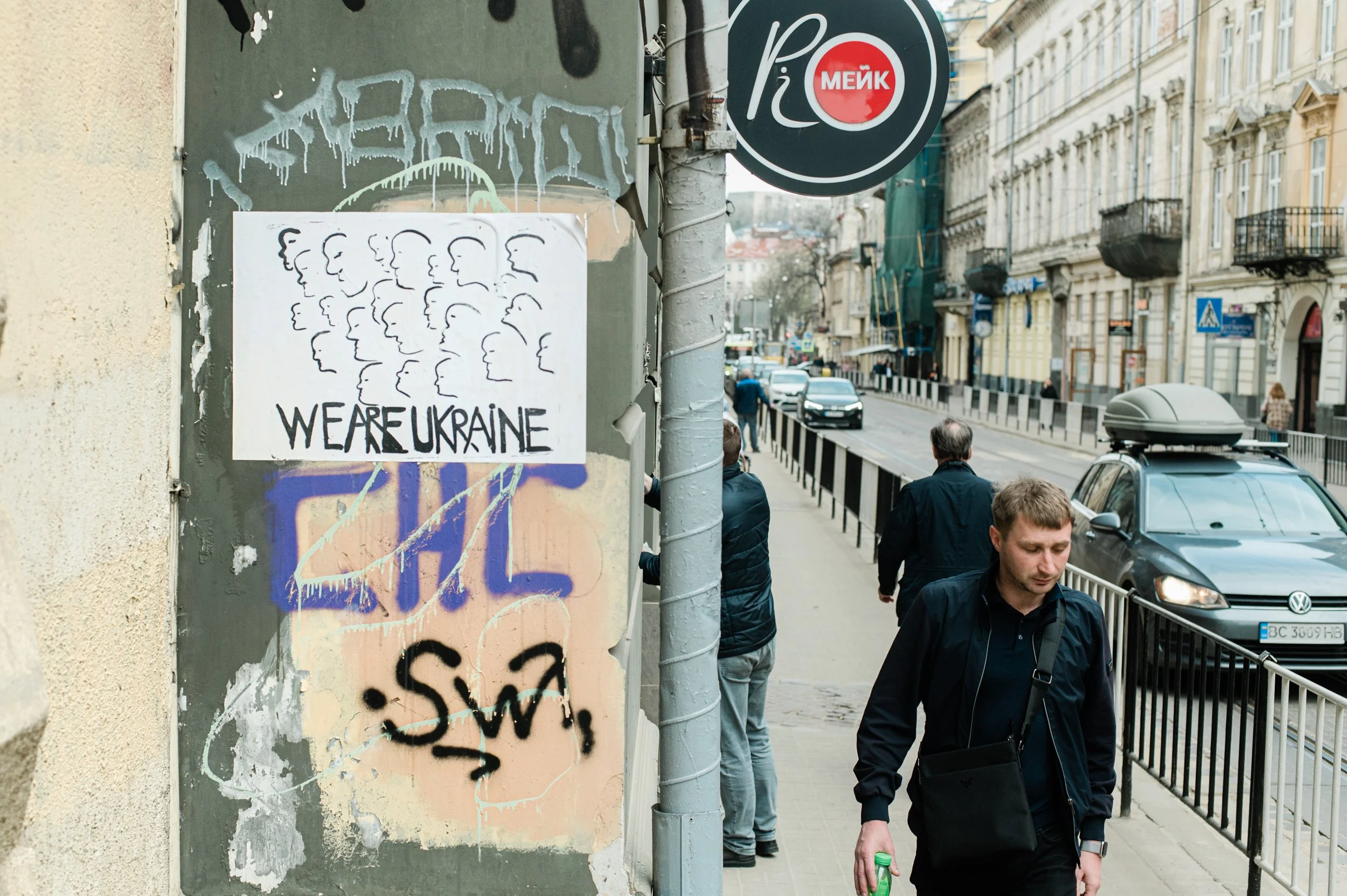
A man walks by a poster entitled, “We are Ukraine,” near the Lviv National Art Gallery in Lviv, April 15, 2022.

Targets imprinted on drawings of Russian President Vladimir Putin line the entrance of a gun shop in Lviv, April 15, 2022.

In Lviv, an illustration depicts Russian President Vladimir Putin cutting a Z-shaped wound into his stomach, with troops colored in red spilling out, April 15, 2022. The letter has been painted on Russian military vehicles during its recent invasion of Ukraine. In early March the Russian Ministry of Defense said it stood "for victory."

A young woman boards a bus in Old Town, Lviv, April 15, 2022.
On April 15, I met two Ukrainians, Denis Bredeliev, 18, and Tymofiy, 15, skateboarding on the stone pedestal of a monument of the 17th century poet and politician Taras Shevchenko, whose literary heritage is considered the foundation of modern Ukrainian literature. Tymofiy told me he and his family escaped Mariupol several days after the invasion began, traveling to at least seven other cities in Ukraine before arriving in Lviv early April. His uncle had left early that morning to help Tymofiy’s grandparents escape the besieged city.
“My father said, ‘We need to go, because Mariupol will be destroyed.’ And he was right,” Tymofiy said of the day they left home.
Asked what he feels toward the Russians bombardment of his home city, Tymofiy put it simply: “The Russian Federation doesn’t like Ukrainians.”
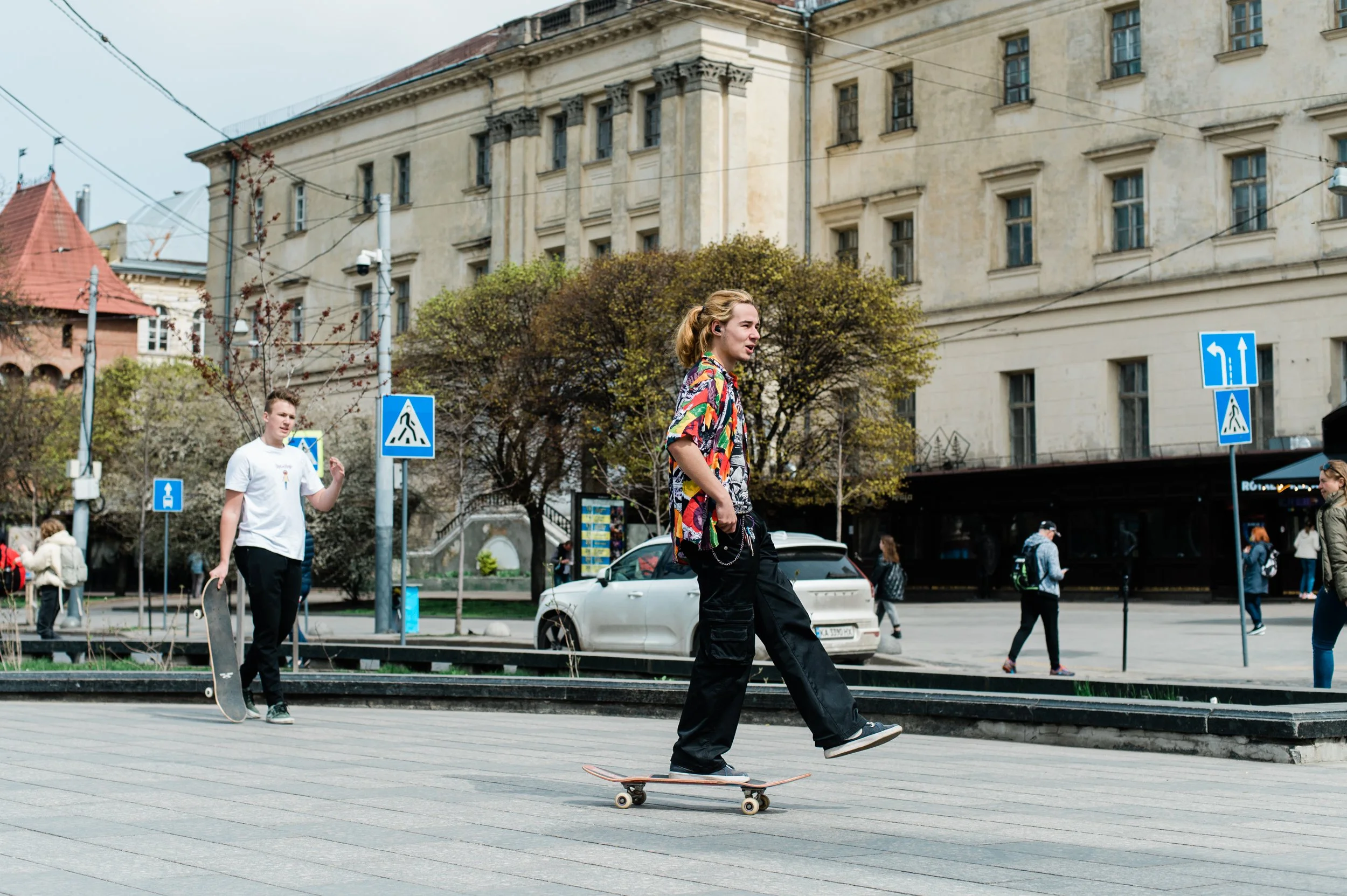
Denis Bredeliev, right, and Tymofiy skateboard near a monument to the 17th century poet and politician Taras Shevchenko in Old Town, Lviv, April 15, 2022. Tymofiy said he was given a Ukrainian-made skateboard as a gift because his own board and the rest of his belongings had stayed behind in Mariupol.
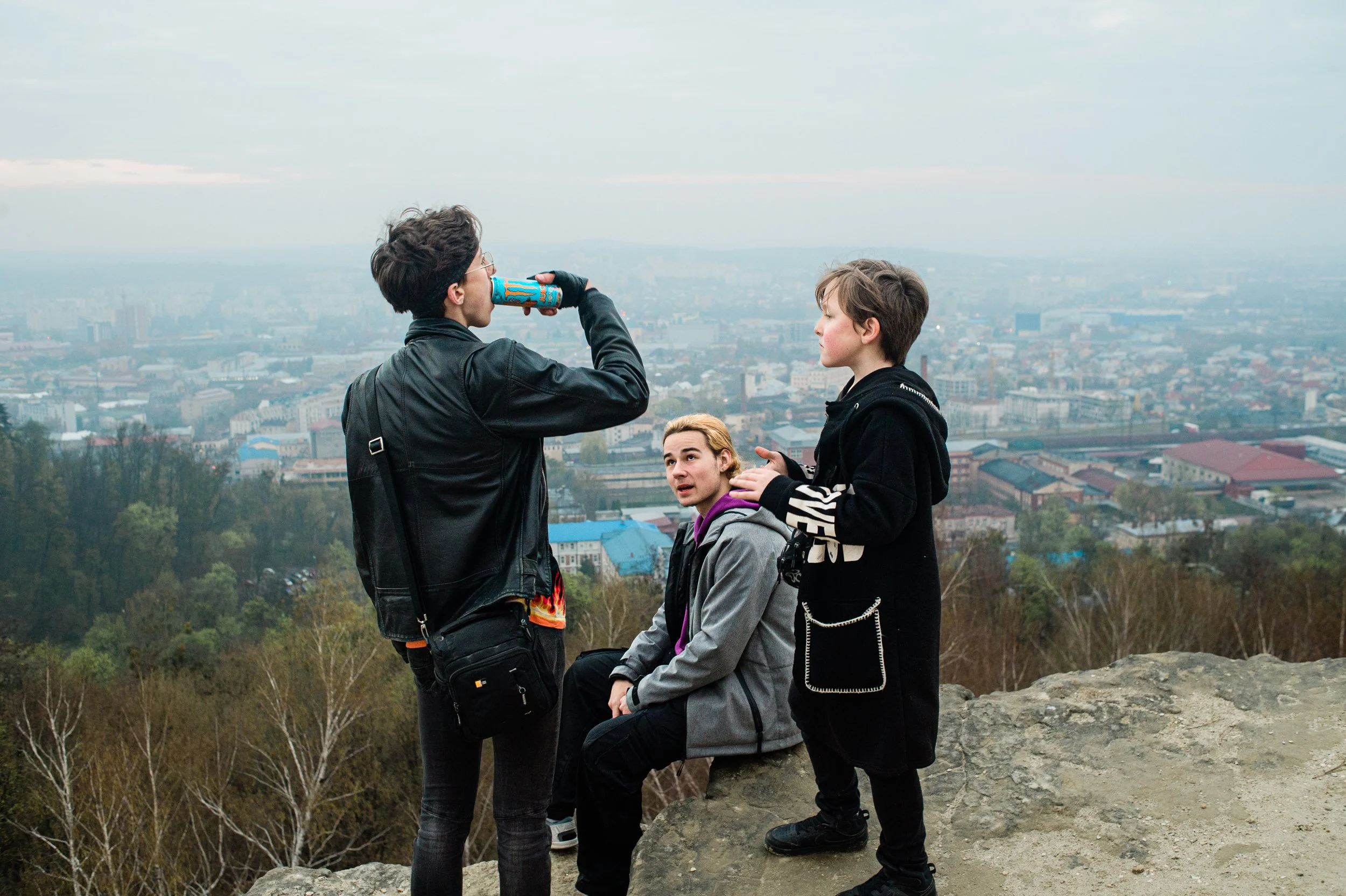
Denis Bredeliev, center, and his friends catch a view of Lviv at sunset atop a hill overlooking the city, April 15, 2022.

An electric tram rides through a street in Old Town, Lviv, April 15, 2022. The streets of the city were filled with hundreds of people, standing in sharp contrast to Kyiv and Kharkiv to the east. After the 10 p.m. curfew went into effect, however, only soldiers and military vehicles could be seen on the streets.
Sirens blare in Lviv, warning people of four incoming missiles that were successfully shot down by the Zenit missile forces of the Ukraine military’s West Air Command, according to A voice on a loudspeaker says, “Help people who are old and sick to leave their places and seek shelter in an underground bunker.”
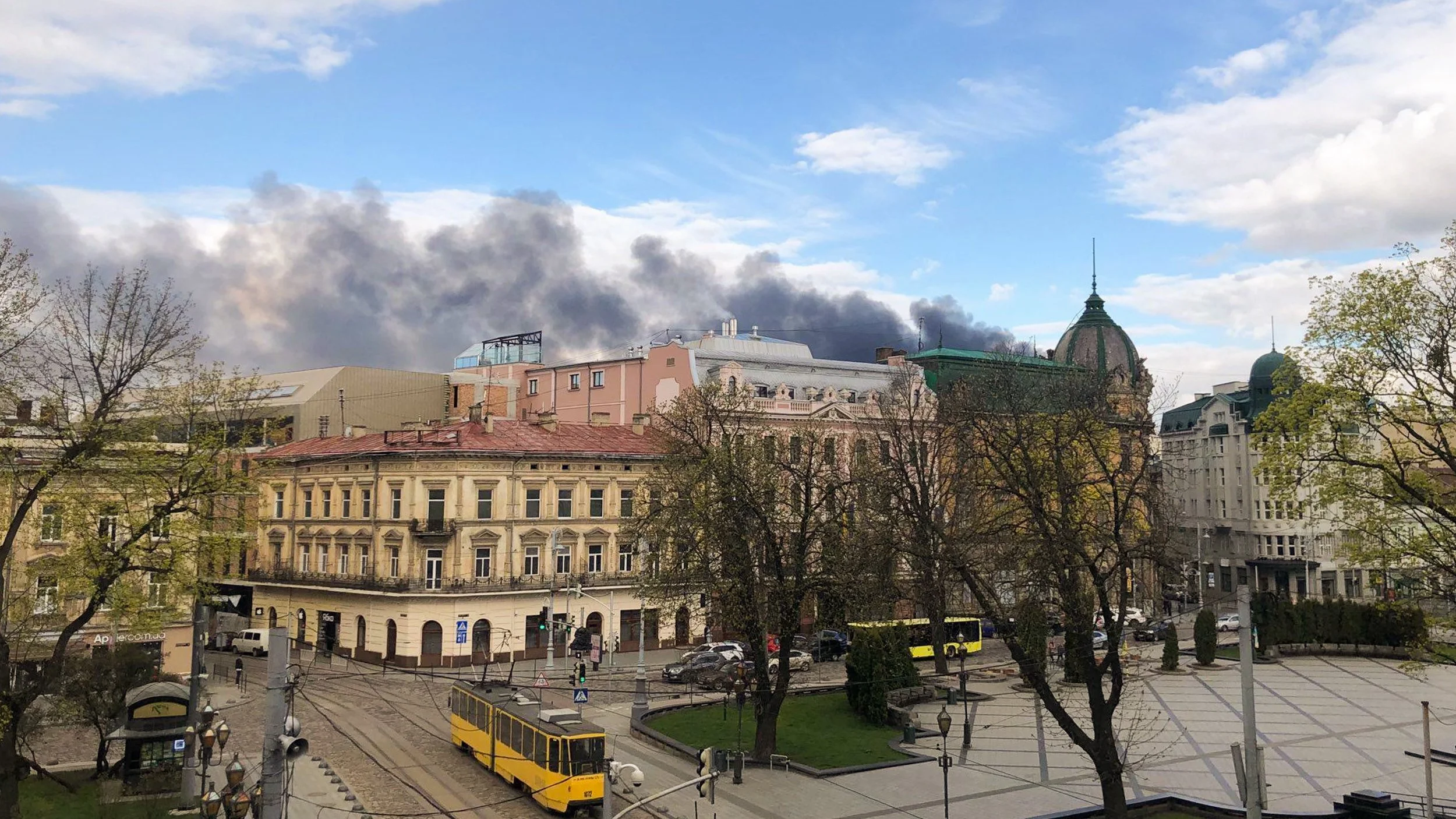
Smoke rises over Lviv’s historic district, caused by a missile strike that killed seven on the morning of April 18, 2022. (Photo by Patrick Adams)
In the early morning of April 15, we heard loud sirens blaring through the streets below our hostel. A man on loudspeaker urged, “Help people who are old and sick to leave their places and seek shelter in an underground bunker.”
The missiles were successfully shot down by the Zenit missile forces of Ukraine’s West Air Command, according to the Ukrainian Air Force.
Three days later, we saw a dark column of smoke rising several kilometers away, learning later that Russian missiles had struck an auto repair shop and nearby military infrastructure overnight, killing seven – the city’s first wartime civilian deaths. A child whose family had fled the northeastern city of Kharkiv lost a finger in the attack. The city’s mayor said one of the explosions was so powerful it shattered the windows of a nearby hotel sheltering a number of Ukrainian refugees.
The shelling was part of a broad offensive operation by Russian forces across Ukraine, including Kyiv and Kharkiv, signaling what experts called a renewed operation to take the eastern Donbas region after a failed attempt to capture Kyiv.
Adams and I rented a car and headed south of Lviv soon after the attack. The previous day we had met a man named Alexiy Yasynskiy at a plaza cafe near Lviv City Hall. Soon after the war began, Yasynskiy, the owner of a large construction company, and three other men decided to use their construction skills and resources to manufacture bulletproof vests for members of the Armed Forces of Ukraine.
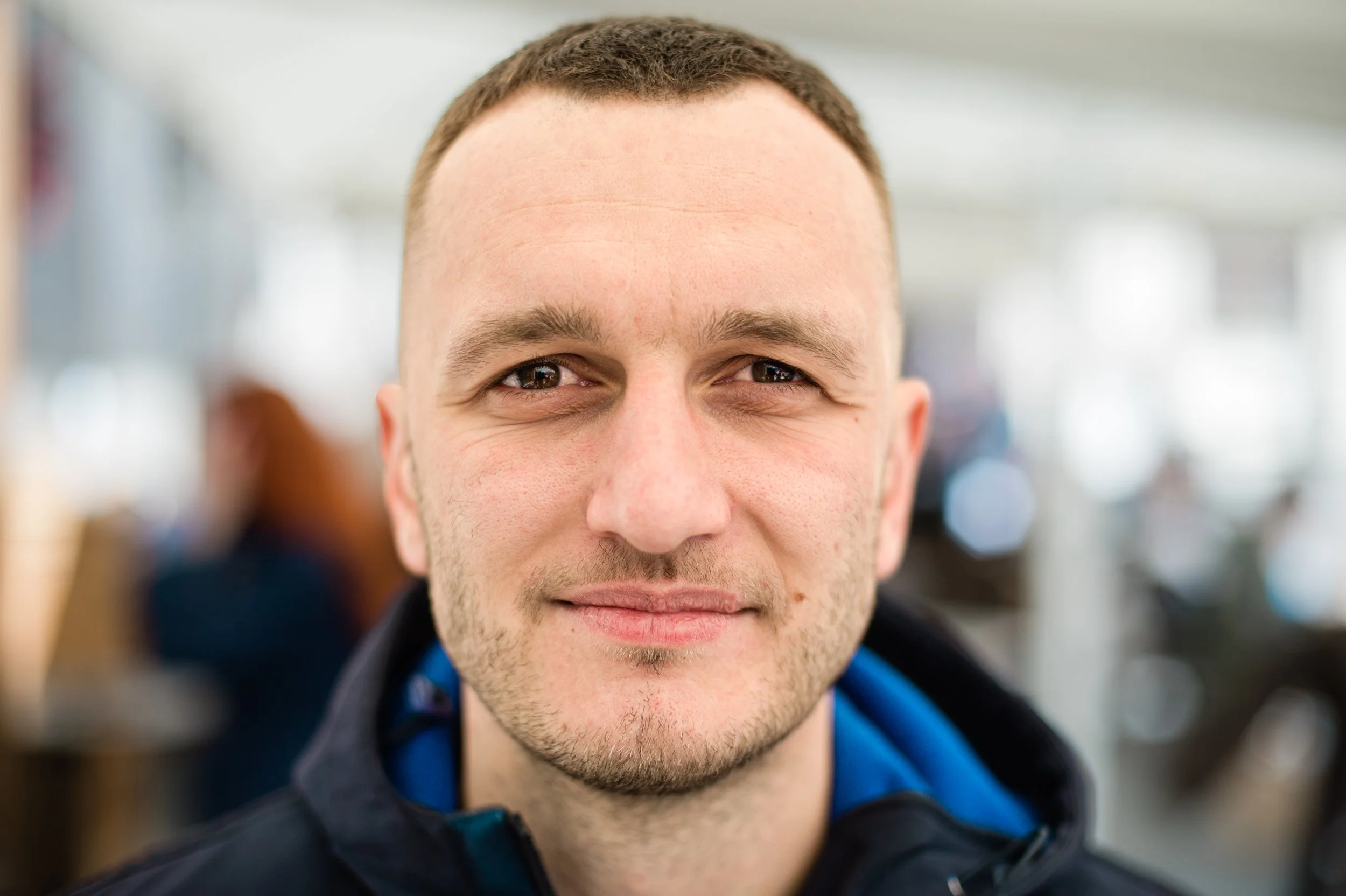
Alexiy Yasynskiy, who with three other men started making bulletproof vests in a large Soviet-era warehouse in western Ukraine, April 17, 2022. He says since his operation began a week after the invasion, he has already distributed more than 10,000 vests to the Armed Forces of Ukraine.

A man named Petro inside a warehouse in western Ukraine who cuts steel plates for the manufacturing of bulletproof vests, April 18, 2022.

Inside a large manufacturing facility in western Ukraine, a batch of metal 'Czech hedgehogs' await distribution further east to impede the advance of Russian tanks and other armored vehicles, April 18, 2022.

A man who had weeks before fled Irpin, a suburb of the Ukrainian capital Kyiv largely destroyed by Russian shelling, operates a machine that cuts steel for the production of bulletproof vests inside a large manufacturing facility in western Ukraine, April 18, 2022.
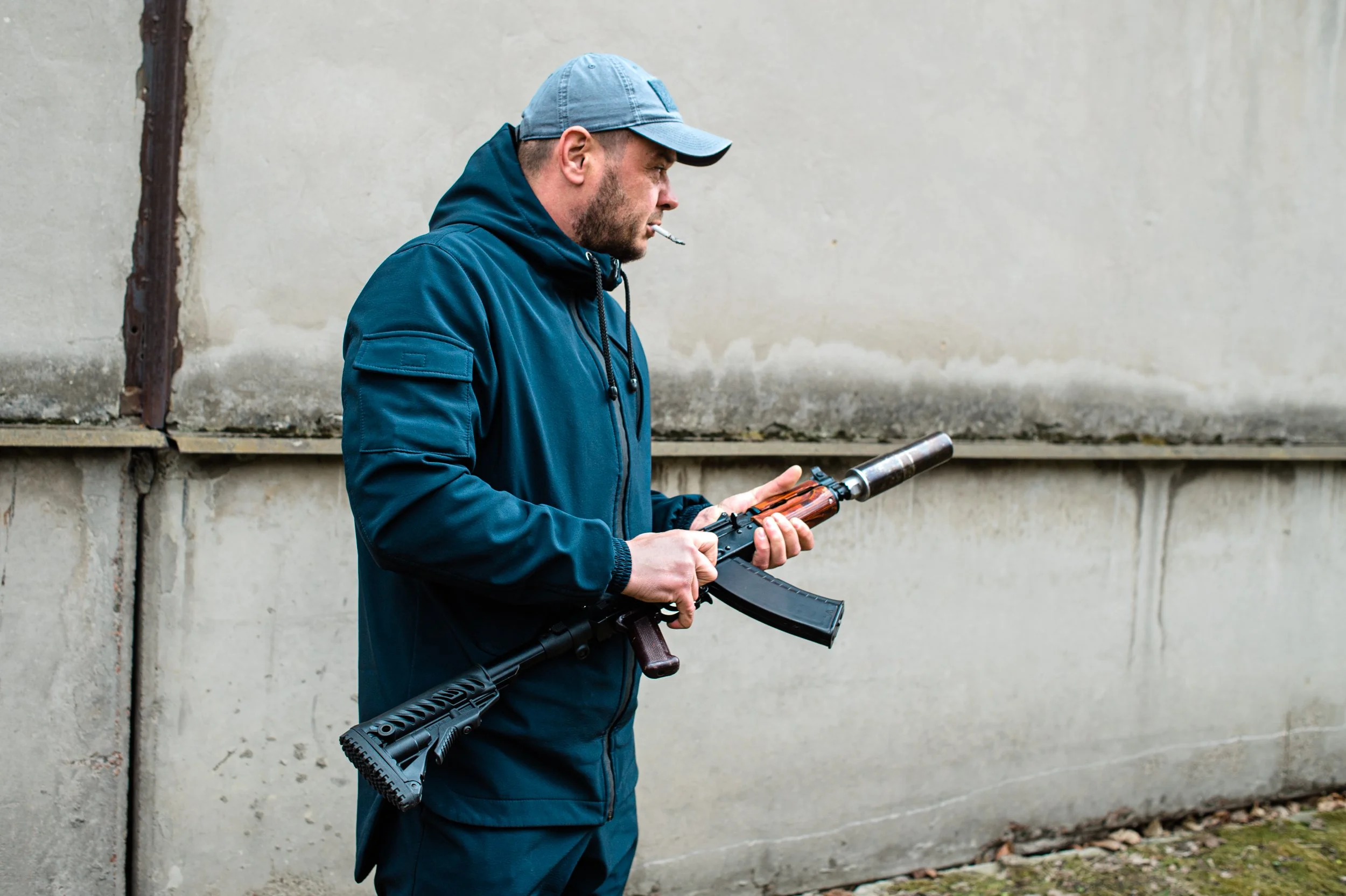
A former member of the Armed Forces of Ukraine, now involved with the manufacturing of bulletproof vests to help the current war effort, prepares to shoot a steel plate with an AK-47 assault rifle to ensure the strength of the metal, April 18, 2022.

A group of men inspect a steel plate after it was hit by two bullets fired from an AK-47 assault rifle, April 18, 2022. The men, homebuilders and construction workers who have teamed up to produce bulletproof vests in western Ukraine, perform the testing to ensure the strength of steel imported from Sweden, Germany, and other parts of Ukraine.

Alexiy Yasynskiy walks by a mound of bulletproof vests, made from steel plates shipped from Sweden, Germany and other parts of Ukraine, awaiting distribution to the Armed Forces of Ukraine to help protect soldiers from Russian bullets and shrapnel. The month-long operation has been conducted inside a large manufacturing facility in western Ukraine.